PLAN THE RIGHT ACCESS
36 Lovett Lane needs a better access plan!
We’re asking the City of Guelph to reconsider a 2014 decision that would route all traffic for a 94-unit development through Lovett Lane.
That decision is based on outdated information, and our neighbourhood streets were not built for this level of traffic.

THE ISSUE

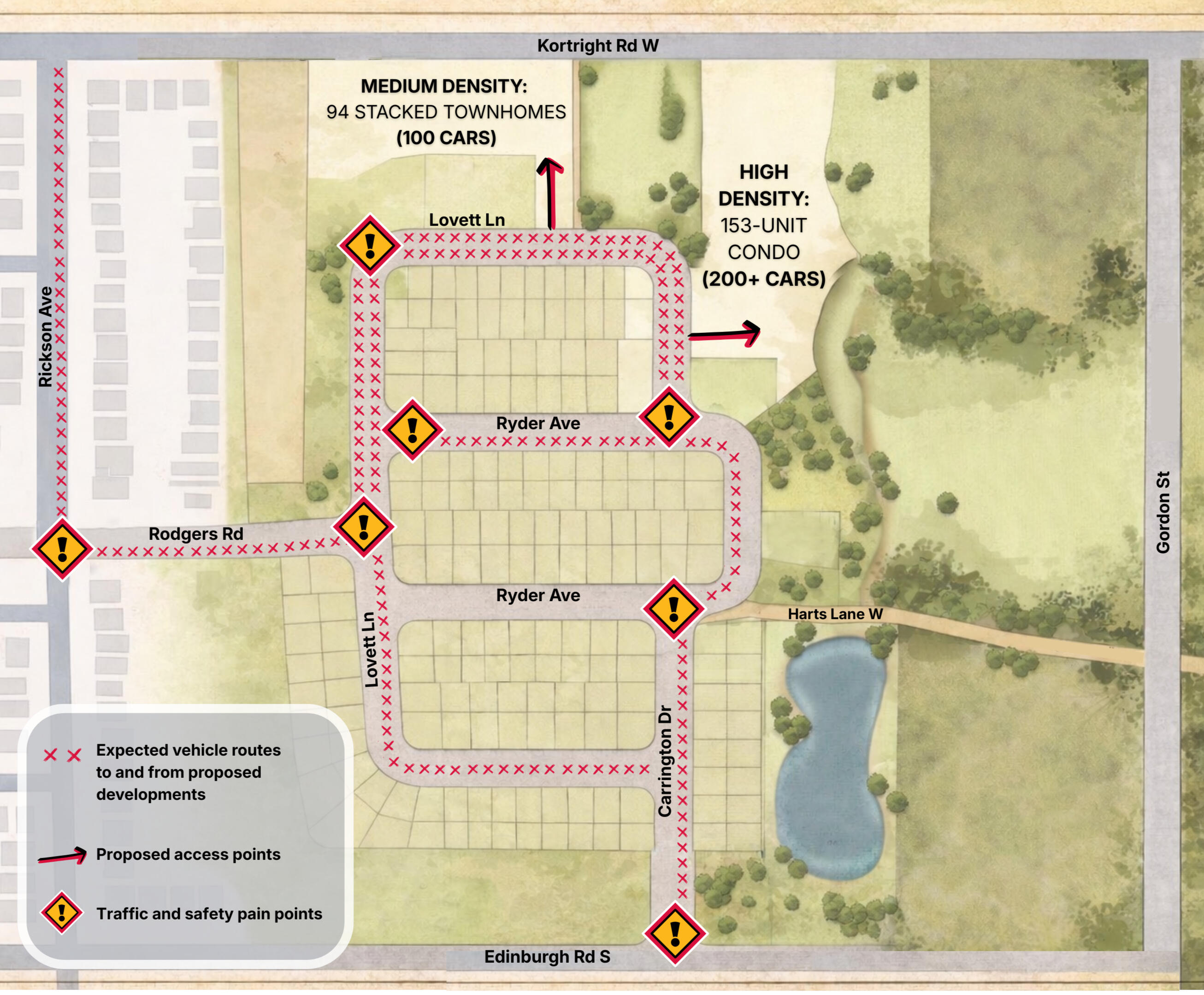
See the roads, turns, and intersections affected
All traffic for a medium-density 94-unit development is currently planned to flow through Lovett Lane and surrounding residential streets.
All traffic for a future high-density 153-unit condo is currently planned to flow through the same streets.
These roads were designed for low-volume neighbourhood use, not as the sole access point for a development of this scale.
THE FACTS

Why the current plan does not work:
Transportation Impact Study Guidelines not being followed:
Section 2.1 of the City’s Traffic Impact Study Guidelines states that the City reserves the right to require an update to an existing TIS if the assumptions and related impacts have changed substantially in land use type, development size, or traffic conditions in the surrounding area.
The development has increased from 48 units to 94 units, significantly increasing expected traffic.
Traffic conditions have also changed, as access to arterial roads is no longer being considered and traffic is instead expected to be routed through internal residential streets.
Traffic patterns have changed substantially, including increased delivery vehicles and larger service vehicles.
Section 3.3.1 states that if a development is to be carried out in phases, traffic impact analysis must be provided for each phase, and that changes to subsequent phases may require an addendum.
The development was sold as single-family units in Phase 1, is currently selling single-family and semi-detached units in Phase 2, with the stacked townhouse units expected as Phase 3 and the apartment units as Phase 4.
Section 3.4.1 states that traffic data less than 3 years old may be considered as base year data, and that where current data is not available, new traffic data should be collected.
The decision is based on a traffic impact study from 2014 and does not reflect current conditions or the internal neighbourhood roads from Phases 1 & 2, including Lovett Lane and Ryder Ave that would now be expected to carry site traffic.
Road capacity and design:
Lovett Lane and Ryder Ave are not standard residential roads, at approximately 7.3 m wide versus the more typical 8.5 m or greater.
On-street parking further reduces usable road width, causing these streets to function as single-lane roads.
The roads are not designed to accommodate the volume of traffic expected of approx. 250 vehicles accessing solely onto the narrow Lovett Lane.
The turning radius at the entrance to 36 Lovett Lane is below standard, which forces larger vehicles into the opposing lane.
The developer has taken lot 7 off the market to use as the access point for construction due to the inadequacy of the turning radius at the entrance to 36 Lovett Lane.
Planning approach:
Standard planning principles for developments of this scale typically include direct access to arterial roads.
Arterial road access points exist, including directly from Kortright Road, which the development is alongside, and the possibility of access through Hart’s Lane at the east end of the development.
Network and infrastructure impact:
Increased traffic will affect not only Lovett Lane, but also surrounding intersections, including Carrington & Edinburgh, Ryder & Carrington, Ryder & Lovett, Rodgers & Lovett, and Rodgers & Rickson.

Neighbourhood considerations include:
Safety:
Children use these streets to get to the local park and nearby school, yet Lovett Lane has only a single sidewalk and no crosswalks.
Increased traffic on narrow residential streets can create congestion, parking conflicts, driver frustration, and a more tense neighbourhood environment.
Entering and exiting driveways will become much more difficult with higher traffic volumes.
These concerns will be made worse by the planned 153-unit high-rise immediately to the east, which is also expected to rely on Lovett Lane access.
Precident:
In Guelph, comparable townhouse and condominium developments are typically given direct access to major arterial roads such as Gordon and Arkell.
We are not aware of any Guelph precedent where a development of this scale relies on a residential laneway for access.
Property Value:
Congestion and the broader impacts of this planning approach may negatively affect the long-term appeal and resale value of surrounding homes.
THE ASK

Based on these issues, we are asking the City of Guelph to revisit the current access plan and properly evaluate safer, more appropriate alternatives.
This includes looking at:
Direct access onto Kortright Road
Access through Harts Lane to Gordon Street
A better solution may be available, but it has not been fully considered.
Take Action
Help us get this plan reconsidered

Contact Decision-Makers to request a review of the current access plan:
Mayor Cam Guthrie: [email protected]Planning Department: [email protected]Ward Councillor Ken Yee Chew: [email protected]Ward Councillor Katherine Hauser: [email protected]
Share with Neighbours:
Send this page to neighbours so more people understand the issue and can get involved.
Follow & Share on Social Media:
@plantherightaccess
Join the Lawn-Sign Campaign:
Let us know in the form below that you would like to take part.

Stay Informed:
Sign up to receive updates and next steps.
FAQ

Are residents opposed to the development?
No. We are concerned that poor access planning will frustrate the whole neighbourhood, and we want the new potential neighbours to know about the planning issues that will affect them as much as us.
What are you asking the City to do?
We are asking the City to review providing the development direct access to the major arterial road of Kortright, which is right beside the development or utilize Harts Lane to Gordon Street.
Why revisit the traffic study?
The city is not following their own guidelines: TrafficImpactStudyGuidelines.pdfThe traffic impact study never studied or analyzed the impact on any of the internal neighbour streets. The streets were not designed with the proper width or directness to accommodate the additional 250+ cars that would now require access through them. It was also completed 10 years ago and doesn’t reflect today’s traffic volume and delivery world realities.
Why are residents concerned?
The main concerns are safety, congestion and parking on narrow neighborhood roads, and the impact on nearby intersections.
Updates

Letter sent to Mayor Guthrie - March 26th
Neighbourhood visit with Ward Councillor Ken Chew - April 1st
Launch of Lawn Sign Campaign - April 25th
Response from Builder & Mayor - April 29th: